
Table of contents
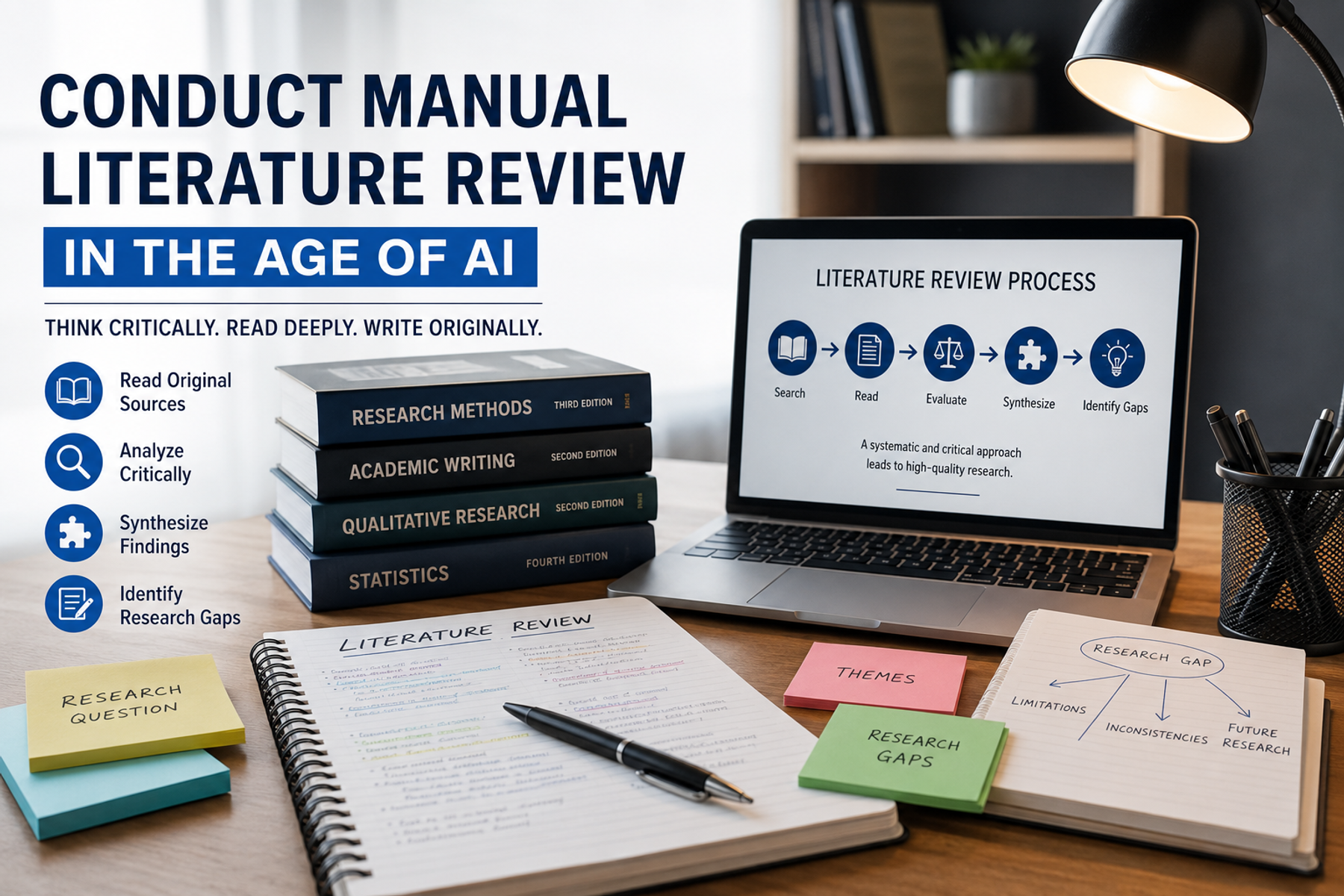
Why Manual Literature Reviews Still Matter
Artificial intelligence can process large amounts of information quickly, but it cannot replace scholarly judgment.
Researchers must decide:
- Which studies are most relevant.
- Whether a methodology is appropriate.
- If the findings are reliable.
- Whether conclusions are supported by evidence.
- Where genuine research gaps exist.
These decisions require subject expertise, critical thinking, and academic experience.
A high-quality literature review reflects the researcher's own understanding of the field rather than the output of a software tool.
What AI Cannot Do
Although AI is useful for administrative tasks, it has several important limitations.
AI cannot reliably:
- evaluate the quality of a research design,
- distinguish between strong and weak evidence,
- interpret findings within their broader context,
- understand disciplinary debates,
- determine whether a research gap is genuinely novel.
Moreover, generative AI systems sometimes produce inaccurate summaries or fabricated references, making independent verification essential.
Step 1: Define a Focused Research Question
Every literature review begins with a clear research question.
For example, instead of selecting a broad topic such as:
Artificial Intelligence in Education
focus on:
The Impact of Artificial Intelligence on Academic Integrity among University Students
A precise research question guides the entire review process.
Step 2: Search Trusted Academic Databases
Rather than relying on AI-generated recommendations, search reputable scholarly databases, including:
- Google Scholar
- Scopus
- Web of Science
- ScienceDirect
- SpringerLink
- IEEE Xplore
- PubMed
- JSTOR
Use carefully selected keywords and Boolean operators to improve the quality of your search.
Step 3: Read the Original Articles
One of the most common mistakes researchers make is relying solely on abstracts or AI-generated summaries.
Instead, read the complete article and pay attention to:
- research objectives,
- methodology,
- sample characteristics,
- findings,
- limitations,
- recommendations.
Only by reading the original paper can you accurately understand the author's contribution.
Step 4: Take Your Own Notes
Instead of copying summaries, prepare your own literature matrix.
Include:
Author
Year
Method
Main Findings
Limitations
Writing notes in your own words strengthens comprehension and reduces the risk of accidental plagiarism.
Step 5: Compare Studies Critically
A literature review should compare studies rather than describe them individually.
Ask questions such as:
- Which findings agree?
- Which findings contradict one another?
- Why do different researchers reach different conclusions?
- How do research methods influence the results?
Critical comparison demonstrates academic maturity.
Step 6: Identify Research Gaps Yourself
Research gaps should emerge from your own reading and analysis.
You may discover:
- inconsistent findings,
- understudied populations,
- outdated methodologies,
- geographical limitations,
- unanswered research questions.
These observations should come from your understanding of the literature—not from AI-generated suggestions.
Step 7: Write in Your Own Academic Voice
Your literature review should reflect your own interpretation of the evidence.
Avoid copying text from any source, whether it is another article or an AI-generated response.
Original academic writing demonstrates integrity and strengthens the credibility of your research.
Common Mistakes to Avoid
Researchers often weaken their literature reviews by:
- depending entirely on AI-generated summaries,
- citing papers they have not read,
- overlooking contradictory evidence,
- using outdated sources,
- failing to synthesize research,
- treating the literature review as a list of article summaries.
A strong review analyses the literature rather than merely describing it.
Best Practices for Conducting a Manual Literature Review
To produce a rigorous literature review:
- Read every paper you cite.
- Prioritize peer-reviewed journal articles.
- Compare studies instead of summarizing them individually.
- Organize the literature by themes or methodologies.
- Verify every citation and reference.
- Maintain detailed notes throughout the research process.
- Develop your own interpretation before writing.
These practices improve both the quality and credibility of your work.
Conclusion
Artificial Intelligence has changed the way researchers search for information, but it has not changed the fundamental purpose of a literature review. Academic research depends on critical thinking, careful reading, and independent analysis—skills that cannot be delegated to software.
Researchers who conduct manual literature reviews develop a deeper understanding of their field, produce more original research, and are better prepared to defend their findings. In the era of AI, the most valuable skill is not knowing how to generate summaries quickly, but knowing how to evaluate evidence thoughtfully and write with academic integrity.
Frequently Asked Questions
Should I use AI for my literature review?
AI may help with organizing information or generating search terms, but it should not replace reading, critical evaluation, or writing. A literature review should be based on your own analysis of the original research.
Why is a manual literature review important?
Manual literature reviews help researchers understand the evidence, identify genuine research gaps, and produce original academic work grounded in critical thinking.
Can universities detect AI-generated literature reviews?
Many universities use a combination of academic review, writing analysis, and institutional policies to evaluate submitted work. Regardless of detection methods, researchers should always follow their institution's guidelines and maintain academic integrity.
References
Booth, A., Sutton, A., & Papaioannou, D. (2021). Systematic Approaches to a Successful Literature Review (3rd ed.). SAGE Publications.
Hart, C. (2018). Doing a Literature Review: Releasing the Research Imagination (2nd ed.). SAGE Publications.
Snyder, H. (2019). Literature review as a research methodology: An overview and guidelines. Journal of Business Research, 104, 333–339. https://doi.org/10.1016/j.jbusres.2019.07.039
Webster, J., & Watson, R. T. (2002). Analyzing the past to prepare for the future: Writing a literature review. MIS Quarterly, 26(2), xiii–xxiii.
Kitchenham, B., & Charters, S. (2007). Guidelines for Performing Systematic Literature Reviews in Software Engineering. Keele University & Durham University.